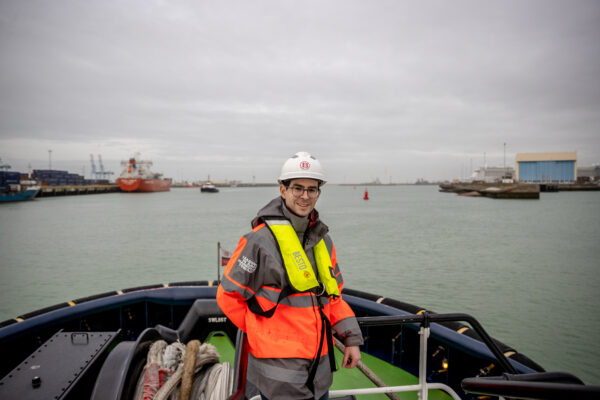
30 years of collaboration between Damen Naval and MULTI.engineering, seen through the eyes of Rob de Gaaij
In the early years of MULTI.engineering, Koninklijke Maatschappij De Schelde — now Damen Naval — played a pivotal role in the creation of Delta Marine Engineering (DME). That joint initiative grew into a long-standing, close collaboration in which craftsmanship, trust and technological innovation continuously reinforced one another.
Rob de Gaaij witnessed that evolution from the front row. On the eve of his retirement, he looks back on the Boelwerf men who arrived in Vlissingen, the transition from 2D to 3D, impressive projects that were realised, and other proposals that ultimately died a quiet death. At the same time, he looks ahead to the future of maritime engineering in a world where ships sometimes need to be ready for new missions even before they are fully designed.
A container full of Belgian shipbuilders
Rob de Gaaij joined De Schelde in 1983 as a naval architect and proposal manager. He later held several management positions.
The first contacts between De Schelde and MULTI.engineering stemmed from the need for additional capacity. Rob explains: “We needed many skilled people to build an amphibious transport ship for the Dutch navy. MULTI.engineering brought them to Vlissingen — quite literally.”
Rob can still picture it clearly. The building in Vlissingen was too small, so containers were set up next to it. “That’s where the MULTI people sat, all in a row: real shipbuilders with a lot of experience.” Integration went smoothly, thanks to team leaders like André Van Landeghem and Walter Janseghers. “They were true craftsmen who forged a close-knit group. Of course, there were differences between Belgians and Dutch people, but they never became an obstacle. The culture here, close to Flanders, is not that different anyway. Besides, we all spoke one clear language: the language of shipbuilding.”
A capacity question that became a partnership
The strong technical affinity still binds both companies today. According to Rob, the collaboration between Damen Naval and MULTI.engineering has never been purely transactional — and still is not. It has never simply been about supplying people or filling hours. It is a long-term relationship built on craftsmanship and trust.
The drive and expertise of Etienne Van Goeye, the founder of MULTI.engineering, were major factors in that. “He constantly wanted to know what was happening in the Dutch and Belgian markets, which projects were coming up, and where collaboration might be possible.”
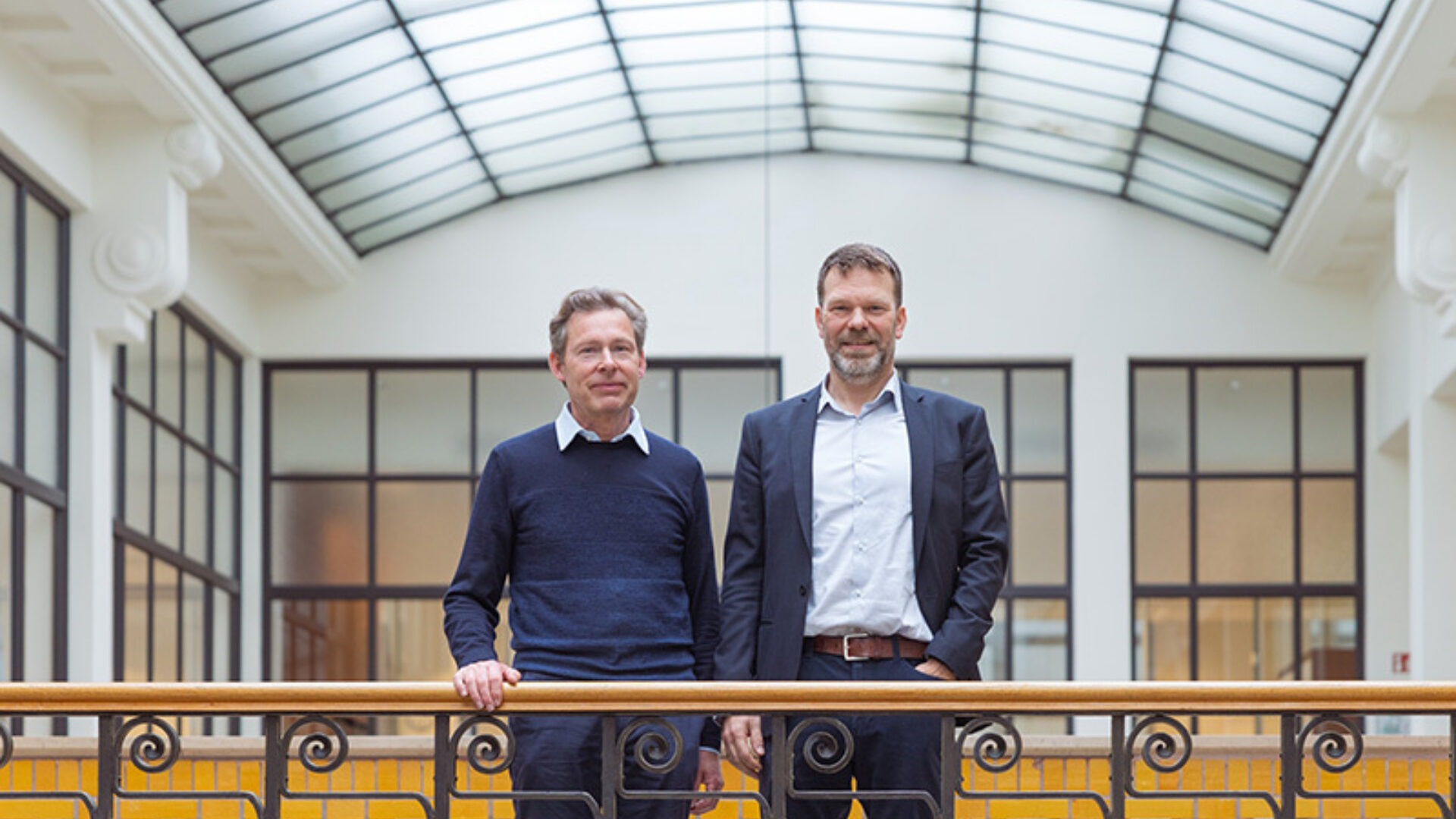
Rob still recognises the same attitude in MULTI.engineering’s current management. Wouter Van Goeye was involved from the very beginning: notably, the establishment of Delta Marine Engineering was signed on his very first working day. Nicolas Van Goeye and Niko Fierens joined the company later. “The intensity of those early years with Etienne was unique, but the vision has always remained the same. MULTI.engineering is still a technically strong organisation that looks beyond the short term.”
The first major technological leap: from 2D to 3D
Anyone discussing thirty years of collaboration inevitably turns to the technological changes that occurred during that period. For Rob, the transition from 2D to 3D was one of the defining moments of his career.
The amphibious transport ship mentioned earlier was designed during that transition period. The lower structure was still drawn in 2D using MicroStation, while the superstructure was developed in 3D for the first time using Nupas. “That really was an experiment,” says Rob. “Nobody had any experience with it. Not us, and not the people from MULTI.engineering and DME either. We went through the introduction together.”
The impact was enormous. Thanks to the 3D models, components could be automatically nested and sent directly to the cutting machines. Work that used to be done manually was suddenly organised much more efficiently. As a result, traditional work preparation changed dramatically.
For Rob, this marked the first real wave of digitalisation in shipbuilding. Databases followed later, along with further integration of design data and, in parallel, new tools and applications such as Cadmatic for piping. But that first step toward 3D remained special. “That was progress, with all the pleasant and less pleasant consequences that come with it.”
Pioneering is second nature
Koninklijke Maatschappij De Schelde became part of Damen Shipyards Group in 2000. “We were often at the forefront of technological innovation,” Rob says. “When the Damen Group acquired Amels Yachting, many of our shipbuilding systems and working methods were also implemented there. The first large yachts — 80 to 90 meters long — were still engineered by De Schelde/Damen Naval and built in Vlissingen. Later, yacht building became a separate entity called Damen Yachting.”
The knowledge gained in naval shipbuilding also found its way into commercial shipbuilding. Rob recalls designing a bitumen tanker. “Those were different from naval ships. Different standards, different procedures, and a less bureaucratic way of working, too. Even so, the teams handled it well.
Commercial and naval engineering were separate disciplines, each with its own engineers and managers. But the tools and the way of working were familiar. We spoke the same technical language.”
Rapid deployment on English soil
One anecdote that stayed with Rob concerns a project in Newcastle. “Around ten people from De Schelde and MULTI.engineering were called on a Sunday evening and left for England just a few days later. They went to Swan Hunter Shipyard for a project involving LPDs for the Royal Navy and stayed there for more than a year and a half. Their direct approach sometimes clashed with the hierarchical organisation, but their technical expertise clearly made a difference overseas as well. And working so intensely with such a team abroad was, of course, an unforgettable adventure for everyone.”
The end of a generation
Around 2010, a large share of the first generation of DME people retired. In a short period of time, an enormous amount of experience disappeared. “You could see it coming,” says Rob, “but that does not mean you can simply absorb it.”
The world had also changed. Engineering had become more international. While Damen Naval focused strongly on Romania, MULTI.engineering built capacity in Slovakia.
A sector that moves with calm and rough seas
Maritime engineering has its ups and downs. Rob has never known it any other way. Major projects are won and provide direction for an organisation for years. But just as easily, you can work on a proposal for two years only for it not to go ahead in the end. “It is not a cookie factory: when something goes wrong, things immediately become very tense.”
Naval shipbuilding is becoming strategic again
Today, Rob sees naval shipbuilding gaining strong momentum again. Geopolitical tensions are rising, and countries want to strengthen their maritime capacity. That means more work for the industry, but also more pressure.
“There is more work coming our way than the industry can handle,” he says. “And lead times are getting shorter. What a ship needs to do sometimes changes during the design process itself. Drones, unmanned systems and UXVs create new design requirements. That calls not only for different ships but also for different processes.”
According to Rob, defense organizations should therefore prescribe less exactly how a ship should be built and focus more on what it ultimately needs to be able to do. The solution then shifts more toward the industry. “That is a good thing. If we are involved earlier, we can arrive at a better solution together.”
Proud of innovation, proud of the craft
When asked which project he looks back on with particular pride, Rob does not immediately name a large naval vessel. Instead, he first thinks of the Surface Effect Ship, an innovative concept from the 1990s.
“It was a kind of catamaran that was inflated with air to enable it to sail faster. We worked on it for several years, from research through to the prototype. There was a market for it, too, but when the oil price fell, the business case became more difficult. Even so, I found that project extremely interesting from a technical point of view. You were truly at the front end of innovation.”
Rob also takes pride in the patrol vessels for the Royal Netherlands Navy. As proposal manager, he was closely involved in the contract and design phases. “When you have designed a ship yourself, it feels a little bit like your own ship.”
Above all, after more than forty years in shipbuilding, Rob feels deep pride in the profession. “Ship engineering never became routine. Every project is different. The job is technically and relationally interesting and always challenging.”
Memorable parties
According to Rob, the value of the collaboration with MULTI.engineering lies exactly here: in the shared craftsmanship, the trust, and the people who have continued to find one another over the years. “And their parties? They were memorable,” Rob laughs. “Grand. We always loved being there whenever MULTI.engineering had something to celebrate.”
This year, that time has come again: MULTI.engineering is celebrating its 30th anniversary. If there is one thing Rob has learned, it is that you should never casually skip a MULTI party 😊
Ship engineering never became routine. Every project is different. The job is technically and relationally interesting, and always challenging.”