R&D – Exploring the future of autonomous, zero-emission estuary shipping
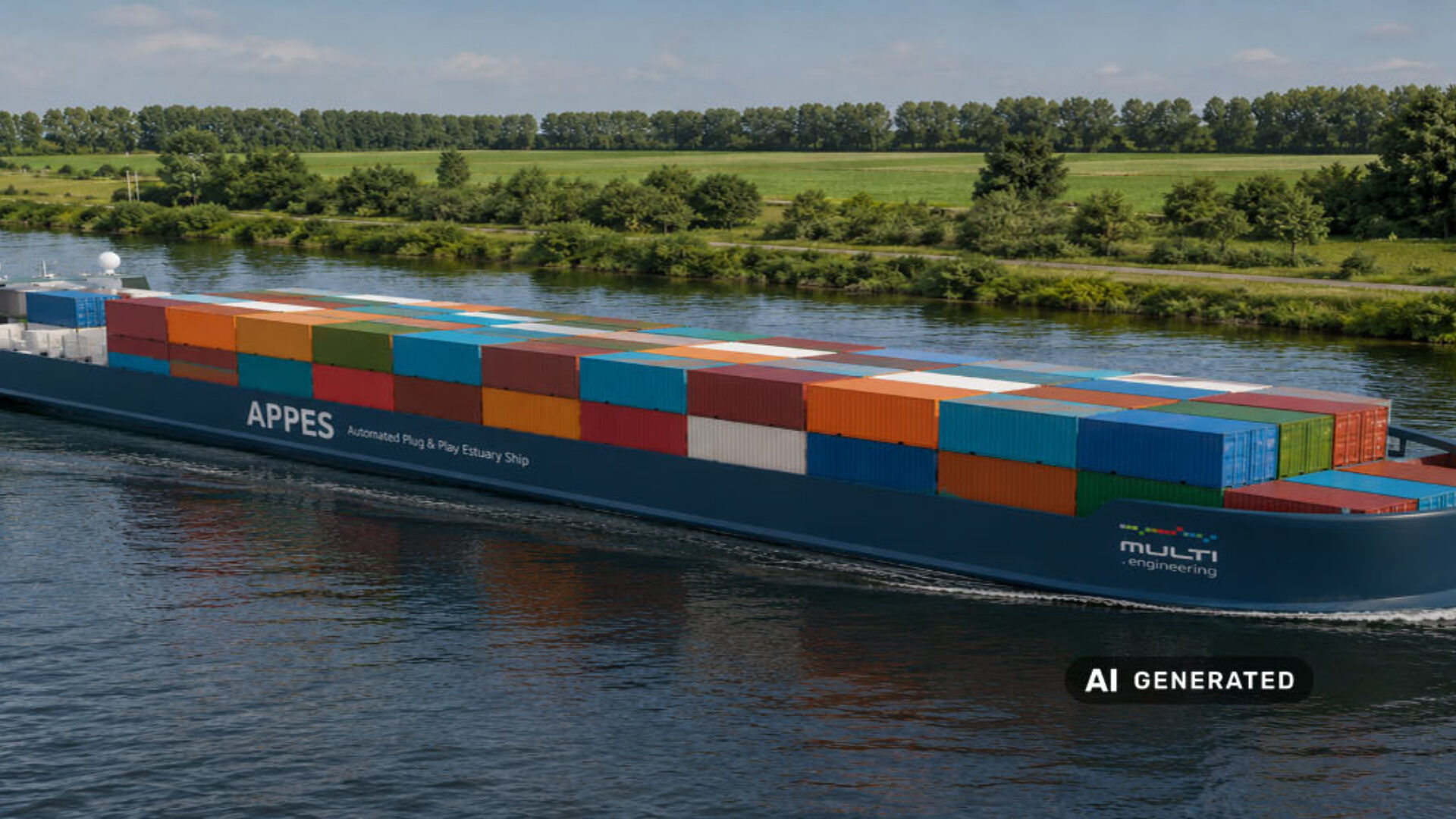
Inland waterway transport plays an important role in the sustainable movement of goods and is expected to further reduce road congestion and emissions. To support this transition, MULTI.engineering investigated the feasibility of an Automated Plug-and-Play Estuary Ship (APPES), a novel vessel concept combining autonomous operation, modular systems, and hydrogen-based propulsion.
More cargo, less downtime
The APPES concept aims to increase cargo carrying capacity while reducing operational costs and emissions. By eliminating conventional onboard accommodation, wheelhouse facilities, and engine room arrangements, additional space becomes available for cargo. The vessel is further designed around modular plug-and-play components, enabling faster maintenance and replacement of critical systems while reducing vessel downtime.
Putting the concept to the test
Within the feasibility study, MULTI.engineering assessed the technical, operational and economic viability of a hydrogen-electric estuary vessel based on a 130 m x 15 m CEMT Class Vb platform. The project investigated the integration of liquid hydrogen storage, PEM fuel cells, battery-supported propulsion systems, and modular containerised equipment that can be exchanged rather than maintained on board. Concepts were also developed for plug-and-play access depots, service hubs, and mobile support units to enable shore-based maintenance and operation. In parallel, studies were performed on vessel performance, energy consumption, cargo capacity, operational availability, safety and lifecycle costs.
Technical feasibility, commercial challenges
The results indicated that autonomous operation and modular maintenance strategies could significantly increase cargo carrying capacity and vessel availability while supporting zero-emission transport. However, the study also showed that the economic viability of the concept strongly depends on the availability of supporting shore-side infrastructure and continued reductions in hydrogen and fuel cell costs. While the APPES concept demonstrated clear technical potential, further developments in hydrogen supply chains, automation technologies and supporting infrastructure are required before large-scale deployment can become commercially attractive.